


PhD Position
PhD Position – Low-Dose STEM-EELS Data Analysis of Beam-Sensitive Materials View the full job advertisement on the EPFL website → We are seeking a highly motivated PhD candidate to join our research team in developing state-of-the-art Low-Dose Electron Microscopy and Electron Energy-Loss Spectroscopy methods to characterize beam-sensitive functional materials. Specifically, the project will investigate photocatalytic semiconductors and their interfaces with biopolymers that modulate their energy-conversion performance. This multidisciplinary project is conducted in close collaboration between EPFL (Switzerland) and the Adam Mickiewicz University (Poland). Key Responsibilities Develop and apply low-dose STEM-EELS and cryo-electron microscopy techniques to characterize fragile organic-inorganic interfaces down to atomic resolution. Develop and implement data analysis methods (in Python) to extract meaningful physical insights from low signal-to-noise datasets. Collaborate closely with international synthesis and theory teams to model and correlate experimental observations. The Successful Candidate Should Possess Masters degree in Physics, Materials Science, Physical Chemistry, or a closely related field. Programming Skills: knowledge of Python for data processing, scientific computing, or scripting. Some experience or theoretical background in transmission electron microscopy (TEM/STEM), EELS, or cryo-EM is desirable but not required. Curiosity for multidisciplinary research at the intersection of electron microscopy, energy materials, and biopolymers. Proficiency in spoken and written English is also required. What We Offer A state-of-the-art research environment equipped with modern electron microscopy facilities and computing tools. Direct involvement in an international, highly collaborative interdisciplinary grant project. Full-time contract of a duration up to 4 years, subject to the standard requirements of the EPFL PhD program.Starting date: January 2027. How to Apply Interested candidates are invited to contactProf. Cécile HébertandDr Pau Torruellawith a curriculum vitae and motivation letter. Prof. Hébert and Dr Torruella can also be contacted for any further details on this PhD opening. Prof. Cécile Hébert:cecile.hebert@epfl.ch Dr Pau Torruella:pau.torruellabesa@epfl.ch EPFL Doctoral Program in Physics The position requires acceptance into the EPFL Doctoral Program in Physics (EDPY). Details on the EDPY program and application process can be found on this page: Discover the EDPY PhD Program → Applications will be considered outside of the standard deadlines, subject to pre-screening by the LSME.
Tenure track professorship for women in the field of Computational Microscopy
About the Institution Institution: Graz University of Technology Department: Institute of Electron Microscopy and Nanoanalysis (FELMI) Location: Graz, Austria Job Offer The position focuses on the computational processing, modeling, and analysis of high-dimensional measurement data. Its core areas include algorithmic reconstruction, uncertainty quantification, data-driven analysis, and the development of scalable workflows for the acquisition, processing, evaluation, and interpretation of complex data structures. Experimental data are generated using physical, imaging, and spectroscopic measurement techniques. The resulting raw data are transformed into reliable insights into key material properties through the application of quantitative models and modern data-driven methods. The research profile integrates computational modeling, quantitative information science, fundamental physics, and materials science into a coherent and interdisciplinary research approach. The position initially is a University Assistant with Doctorate, 40 hours per week, at the Institute of Electron Microscopy and Nanoanalysis. Upon establishment of a qualification agreement, the candidate will be appointed Assistant Professor. Fulfilling the qualification agreement implies appointment as a tenured Associate Professor. Requirements Completed university degree with a PhD in Physics, Chemistry, Mathematics, Computer Science, or Data Science Outstanding scientific achievements at the interface of experimental research and data science Excellent written and spoken English skills Position Details Opening date: 01.10.2026 Closing date: 25.11.2026 Contact Name: Werner Grogger Contact’s email: werner.grogger@felmi-zfe.at Interested in this position? View Job Advertisement →
X-ray/TEM Postdoctoral Researcher
POSTDOCTORAL POSITION X-ray/TEM Postdoctoral Researcher 📍 Cerdanyola del Vallès (Barcelona), Spain | 🔬 Materials Science | 🎓 Research About the Institution Institution: ALBA Synchrotron Light Facility Department: Experiments Service: Interdisciplinary and Multimodal Section Location: Cerdanyola del Vallès, Barcelona, Spain Job Offer This postdoctoral position focuses on the development of scientific and technical methods for correlative operando X-ray Absorption Spectroscopy (XAS) and (Scanning) Transmission Electron Microscopy ((S)TEM), within the framework of the IMPRESS project (Interoperable electron Microscopy Platform for advanced RESearch and Services), funded by HORIZON-INFRA-2022-TECH-01-01. The IMPRESS project aims to develop an interoperable platform based on a modular and standardized cartridge concept. These cartridges are designed for integration into TEM specimen and aperture holders, as well as other instruments used for sample preparation and characterization, including surface science tools, transport measurement systems, microfocus X-ray tomography instruments and synchrotrons. Within IMPRESS, ALBA contributes to the development of a MEMS-based microreactor for correlative photocatalytic experiments in TEM and synchrotron beamlines. These experiments target CO2 reduction reactions and the generation of high-value products. The successful candidate will report to the Head of the Interdisciplinary and Multimodal Section and work closely with the Interface X-ray/TEM and Methodology groups, beamline scientists, the Joint Electron Microscopy Center at ALBA (JEMCA), and project partners. The main focus of the position will be the testing of microreactor prototypes using (S)TEM and X-ray beamlines. Candidate Profile Candidates must hold a PhD in Chemistry, Materials Science, Nanotechnology, Physics, or an equivalent field, and have hands-on experience in (S)TEM and/or synchrotron X-ray techniques. Position Details Opening date: September 30, 2026 Application deadline: November 15, 2026 Contact: Lucia Aballe Email: laballe@cells.es Interested in this position? Find further information about the position and application procedure on the official ALBA recruitment website. View Job Advertisement →
PhD position quantitative electron microscopy of fuel cell materials
PhD Position Quantitative Electron Microscopy of Fuel Cell Materials 📍 Marburg, Germany 🔬 Physics 🎓 Academia About the Institution Institution: Marburg UniversityResearch Field: PhysicsSector: AcademiaLocation: Marburg, Germany Job Offer PhD position quantitative electron microscopy of fuel cell materials The selected PhD candidate will focus on the advanced characterization of fuel cell materials using state of the art electron-microscopy based techniques, including a new microscope in a specifically designed research building. In-situ methodologies should be applied with the aim of understanding fuel cell behaviour under realistic conditions. The position offers access to advanced instrumentation and working in an international team of highly motivated researchers. If desired, structured training is available. For more details please see the job advertisement. Candidate Profile MSc-degree or equivalent in Physics, Material Science, or a similar discipline A strong foundation in solid-state physics Enthusiasm for experimental research and working with cutting-edge instrumentation Experience in electron microscopy Basic knowledge of ceramic materials Interested in this position? Find the full job advertisement and application details on the Marburg University recruitment website. View Job Advertisement → Contact Kerstin Volz kerstin.volz@physik.uni-marburg.de
Research Associate in Environmental Electron Microscopy
Institution University of York Department: School of Physics Engineering & Technology Service: Academia Location: York, United Kingdom Description We are seeking a Postdoctoral Research Associate specialising in advanced environmental electron microscopy to join the team at the Jeol York Nanocentre, a world-leading facility specialising in environmental electron microscopy at atomic resolution. The post is part of the project ‘Uncovering a Catalyst in action at the Atomic Level (U-CAL): a shortcut to net-zero technologies’ an EPSRC International Centre-to-Centre Collaboration Network that includes Universities of York, Nottingham and the Helmholtz-Zentrum Dresden-Rossendorf Dresden, Germany. This role will be based at the York Jeol Nanocenter. This project aims to visualise active sites in functioning catalysts under real reaction conditions and in real time. The successful candidate will contribute to a broad range of experimental investigations, modelling, and data analysis. This includes operando atomic-scale imaging and local probe spectroscopy of heterogeneous catalysts in action. The overarching goal is to understand how electron dose, substrate support, and other external stimuli influence the atomic structure of nano catalysts, ultimately determining their efficiency. Examples of reactions to be studied include, but are not limited to, high-efficiency catalysts for CO₂ hydrogenation and ammonia synthesis. This role offers an initial 24-month appointment with the possibility of up to an additional 24-month extension. You will work with advanced instrumentation and develop workflows for image processing and object tracking to reveal the structure of reactive intermediates. You will also collaborate closely with national and international partners. Requirements A PhD in Physics, Chemistry, Materials Science or related subject. Experience in the operation of transmission electron microscopes and in environmental electron microscopy. Strong analytical skills and experience with data interpretation, simulations, and/or modelling. A track record of high-quality peer-reviewed publications. Excellent communications skills. More information & application For further information or to apply for this position, please visit the following link: VIEW JOB OFFER & APPLY Job details Opening date: July 29, 2026 Closing date: September 9, 2026 Contact: Demie Kepaptsoglou Email: demie.kepaptsoglou@york.ac.uk
Postdoctoral position in ELECTROCHEMICAL OPERANDO TRANSMISSION ELECTRON MICROSCOPY and ELECTROCHEMICAL OPERANDO SPECTROSCOPIES of functional materials for CO2 and H2 technologies
Institution ISTITUTO ITALIANO DI TECNOLOGIA Department: CENTER FOR SUSTAINABLE FUTURE TECHNOLOGIES Service: research institute Location: TORINO, Italy Description The main focus of the research will be on the operando Electrochemical Liquid Phase Transmission Electron Microscopy (EC-LPTEM), that will be complemented with one or more of the spectroscopic operando techniques available in the Center. Collaborative research with colleagues preparing the functional materials for the mentioned applications will be another essential focus. Your main responsibilities will be: Supporting the optimization of experimental protocols for operando EC-LPTEM and operando spectroscopy Take the responsibility of the operando characterization of the materials selected to advance in the Research line activity Supporting optimization protocols to perform correlative operando measurements Requirements PhD in Material Science, Electrochemistry, Chemistry or Physics or equivalent degree Hands-on experience in electrochemistry Hands-on experience in TEM Hands-on experience on EC_LPTEM Hands-on experience with one among XRD, Raman spectroscopy, IR spectroscopy, NAP-XPS, SECM, AFM Experience on one of operando XRD, operando Raman operando spectroscopy, IR operando spectroscopy, NAP-XPS will be highly evaluated Experience with scanning electron microscopy will be positively evaluated Further experimental skills are an advantage Good communication skills in English Strong problem-solving attitude High motivation to learn Spirit of innovation and creativity Good at time and priority management Ability to work in a challenging and international environment Ability to work independently and collaboratively in a highly interdisciplinary environment More information & application For further information or to apply for this position, please visit the following link: VIEW JOB OFFER & APPLY Job details Reference: Dr. Angelica Chiodoni Opening date: July 10, 2026 Closing date: August 28, 2026 Contact: angelica.chiodoni@iit.it Detailed job offer You can upload or consult the detailed document about this job offer. Download the detailed job offer (PDF)
PhD Scholarships in “live”electron microscopy in catalysisat the atomic-scale – DTU Physics
Institution: DTU Physics | Location: Kgs. Lyngby, Denmark Job Description Are you driven to observe catalysts in action—atom by atom, in real time, under realistic conditions? Do you want to use state-of-the-art electron microscopy to answer fundamental questions at the frontier between catalysis, chemical, materials and quantum sciences? We are recruiting Postdocs to explore catalytic materials using state-of-the-art operando, atomic-resolution transmission electron microscopy (TEM). Why join VISION? At VISION, you will join a highly collaborative, international, and interdisciplinary research environment where advanced electron microscopy and spectroscopy, microfabricated reactors, catalysis, cluster science, and computational modelling come together to reveal how catalysts function at the atomic scale. This is an exceptional opportunity for ambitious researchers who want to shape the frontier of “live” electron microscopy and wants to build foundation for independent academic or corporate research career. Your Impact Catalysts are metastable nanomaterials. Their active surface sites dynamically restructure during adsorption and reaction of molecules. However, many of these processes remain hidden because they occur at the atomic scale and in real time. Your research will address this challenge by using the new VISION PRIME electron microscope, a state-of-the-art instrument designed for operando and low-dose-rate atomic-resolution TEM studies. You will contribute to a deeper mechanistic understanding of catalytic processes and help guide the design of next-generation catalyst materials. What You’ll Do Depending on your background and interests, you will undertake research activities such as: Performing operando, low-dose-rate TEM to capture real-time atomic-scale catalyst dynamics. Advancing ultrasensitive imaging and spectroscopy of gas–surface interactions, molecular adsorption, and active-site formation. Fabricate and use microfabricated reactors for realistic catalytic environments. Visualize, quantify and interpret nanoparticle restructuring, vibrations, and surface dynamics. Develop and apply Python-based image/data analysis tools for large time-resolved TEM datasets. Establish quantitative links between 3D atomic structure, dynamics and catalytic functions of single nanoparticles. Collaborate with computational researchers to atomic-scale mechanisms, kinetics, and strategies for stabilizing active catalytic structures. Contribute to high-impact scientific publications and present your results at international conferences. Take an active role in shaping new research directions within the VISION environment. Qualifications Your application must include a concise description of your research skills and experience. We favor candidates with a degree in physics, chemistry or materials science. Candidates must have documented skills in atomic-resolution transmission electron microscopy. Candidates should also have documented experience in one or more of the following areas: microfabricated devices, 2D materials, catalysis and/or surface science. Strong skills in scientific programming, e.g. using Python, is expected. Moreover, the candidate should have obtained an excellent academic track record, demonstrated outstanding problem-solving abilities, and good communication skills in both spoken and written English. Moreover, the candidates should also have proven ability to work both independently and collaboratively in an international top-research team on a relevant scientific question. Formal qualification: As a formal qualification, you must hold a PhD degree (or equivalent). We Offer & Terms of Employment DTU is a leading technical university globally recognized for the excellence of its research, education, innovation and scientific advice. We offer a rewarding and challenging job in an international environment. We strive for academic excellence in an environment characterized by collegial respect and academic freedom tempered by responsibility. The appointment will be based on the collective agreement with the Danish Confederation of Professional Associations. In addition, supplements can be negotiated in accordance with DTU’s salary structure for scientific staff: DTU Salary Structures. It is a full-time position, and the period of employment is 2 years. The starting date is as soon as possible (or according to mutual agreement). Further Information Further information may be obtained from: Professor Christian D. Damsgaard (email: cdda@dtu.dk) Professor Joerg R. Jinschek (email: jojin@dtu.dk) Professor Stig Helveg (email: stihe@dtu.dk) You can read more about VISION at www.vision.dtu.dk and DTU Physics at physics.dtu.dk. If you are applying from abroad, you may find useful information on working in Denmark and at DTU at DTU – Moving to Denmark. Application Procedure Your complete online application must be submitted no later than 30 September 2026 (23:59 Danish time). Applications must be submitted as one PDF file containing all materials to be given consideration. To apply, please open the link “Apply now”, fill out the online application form, and attach all your materials in English in one PDF file. The file must include: Application (cover letter) CV Academic Diplomas (MSc/PhD – in English) List of publications Applications received after the deadline will not be considered. All interested candidates irrespective of age, gender, disability, race, religion or ethnic background are encouraged to apply. As DTU works with research in critical technology, which is subject to special rules for security and export control, open-source background checks may be conducted on qualified candidates for the position. About VISION & DTU The Center for Visualizing Catalytic Processes (VISION) is funded by the Danish National Research Foundation and located at DTU Physics. VISION has developed a new transmission electron microscope platform, VISION PRIME, for visualizing catalytic nanoparticles and reactions at the atomic-level and integrates with cutting-edge TEM methodologies, microfabricated nanoreactors, nanoparticle synthesis and computational modelling. VISION’s activities are centered in DTU’s new “Climate Challenge Laboratory” building. The new laboratory hosts the VISION center, the Surface Physics and Catalysis section, the CatTheory section and the newly established Pioneer Center, CAPeX, as a vibrant collaborative research environment with internationally leading scientists in the fields of catalysis and power-to-X. DTU – For the benefit of society since 1829: DTU is one of Europe’s leading elite technical universities. Through research and education at an international top level, we create solutions to the major societal challenges of our time and help secure Europe’s global leadership in sustainable technological development. DTU has 13,800 students, 1,600 PhD students, and 6,500 employees. Job Info Job Identification: 7870 Job Category: VIP B Posting Date: 08/13/2026, 12:41 PM Apply Before: 09/30/2026, 11:59 PM Location: Fysikvej, Kongens Lyngby, 2800, DK Contact Josephine Thrane KlingeExecutive Administration Officer Center for Visualizing Catalytic Processes / VISION Mob: +45 30 55 30 07 jthkl@dtu.dk FysikvejBuilding 313, 1st floor, room 1262800 Kgs. Lyngbywww.dtu.dk/english
Postdoc in “live” electron microscopy in catalysis at the atomic-scale – DTU Physics
Institution: DTU Physics Location: Kgs. Lyngby, Denmark Job Description Are you driven to observe catalysts in action—atom by atom, in real time, under realistic conditions? Do you want to use state-of-the-art electron microscopy to answer fundamental questions at the frontier between catalysis, chemical, materials and quantum sciences? We are recruiting Postdocs to explore catalytic materials using state-of-the-art operando, atomic-resolution transmission electron microscopy (TEM). Why join VISION? At VISION, you will join a highly collaborative, international, and interdisciplinary research environment where advanced electron microscopy and spectroscopy, microfabricated reactors, catalysis, cluster science, and computational modelling come together to reveal how catalysts function at the atomic scale. This is an exceptional opportunity for ambitious researchers who want to shape the frontier of “live” electron microscopy and build a foundation for an independent academic or corporate research career. Your Impact Catalysts are metastable nanomaterials. Their active surface sites dynamically restructure during adsorption and reaction of molecules. However, many of these processes remain hidden because they occur at the atomic scale and in real time. Your research will address this challenge by using the new VISION PRIME electron microscope, a state-of-the-art instrument designed for operando and low-dose-rate atomic-resolution TEM studies. You will contribute to a deeper mechanistic understanding of catalytic processes and help guide the design of next-generation catalyst materials. What You’ll Do Depending on your background and interests, you will undertake research activities such as: Performing operando, low-dose-rate TEM to capture real-time atomic-scale catalyst dynamics. Advancing ultrasensitive imaging and spectroscopy of gas–surface interactions, molecular adsorption, and active-site formation. Fabricating and using microfabricated reactors for realistic catalytic environments. Visualizing, quantifying, and interpreting nanoparticle restructuring, vibrations, and surface dynamics. Developing and applying Python-based image/data analysis tools for large time-resolved TEM datasets. Establishing quantitative links between 3D atomic structure, dynamics, and catalytic functions of single nanoparticles. Collaborating with computational researchers on atomic-scale mechanisms, kinetics, and strategies for stabilizing active catalytic structures. Contributing to high-impact scientific publications and presenting your results at international conferences. Taking an active role in shaping new research directions within the VISION environment. Qualifications Your application must include a concise description of your research skills and experience. We favor candidates with a degree in physics, chemistry, or materials science. Candidates must have documented skills in atomic-resolution transmission electron microscopy. Candidates should also have documented experience in one or more of the following areas: Microfabricated devices 2D materials Catalysis and/or surface science Strong skills in scientific programming (e.g., using Python) is expected Moreover, the candidate should have obtained an excellent academic track record, demonstrated outstanding problem-solving abilities, and good communication skills in both spoken and written English. Candidates should also have proven ability to work both independently and collaboratively in an international top-research team on a relevant scientific question. Formal qualification: You must hold a PhD degree (or equivalent). We Offer DTU is a leading technical university globally recognized for the excellence of its research, education, innovation, and scientific advice. We offer a rewarding and challenging job in an international environment. We strive for academic excellence in an environment characterized by collegial respect and academic freedom tempered by responsibility. Salary and Terms of Employment The appointment will be based on the collective agreement with the Danish Confederation of Professional Associations. In addition, supplements can be negotiated in accordance with DTU’s salary structure for scientific staff: DTU Salary Structures. It is a full-time position, and the period of employment is 2 years. The starting date is as soon as possible (or according to mutual agreement). Further Information Further information may be obtained from: Professor Christian D. Damsgaard (email: cdda@dtu.dk) Professor Joerg R. Jinschek (email: jojin@dtu.dk) Professor Stig Helveg (email: stihe@dtu.dk) Learn more about VISION at www.vision.dtu.dk and DTU Physics at physics.dtu.dk. If you are applying from abroad, useful information on working in Denmark and at DTU can be found at DTU – Moving to Denmark. Application Procedure Your complete online application must be submitted no later than 30 September 2026 (23:59 Danish time). Applications must be submitted as one PDF file containing all materials. To apply, click “Apply now”, fill out the form, and attach the following in English: Application (cover letter) CV Academic Diplomas (MSc/PhD – in English) List of publications Applications received after the deadline will not be considered. All interested candidates irrespective of age, gender, disability, race, religion or ethnic background are encouraged to apply. As DTU works with research in critical technology, open-source background checks may be conducted on qualified candidates. About the Environment & DTU The Center for Visualizing Catalytic Processes (VISION) is funded by the Danish National Research Foundation and located at DTU Physics. VISION has developed a new transmission electron microscope platform, VISION PRIME, for visualizing catalytic nanoparticles and reactions at the atomic level, integrating cutting-edge TEM methodologies, microfabricated nanoreactors, nanoparticle synthesis, and computational modelling. VISION’s activities are centered in DTU’s new “Climate Challenge Laboratory” building, hosting VISION, Surface Physics and Catalysis, CatTheory, and the Pioneer Center (CAPeX). DTU – For the benefit of society since 1829: DTU is one of Europe’s leading elite technical universities. Founded by Hans Christian Ørsted, DTU has 13,800 students, 1,600 PhD students, and 6,500 employees across campuses in Denmark and Greenland. Job Info Job Identification: 7870 Job Category: VIP B Posting Date: 08/13/2026, 12:41 PM Apply Before: 09/30/2026, 11:59 PM Location: Fysikvej, Kongens Lyngby, 2800, DK Contact Josephine Thrane KlingeExecutive Administration Officer Center for Visualizing Catalytic Processes / VISION Mob: +45 30 55 30 07 jthkl@dtu.dk FysikvejBuilding 313, 1st floor, room 1262800 Kgs. Lyngbywww.dtu.dk/english
18th European Microscopy Congress

16 to 22 September 2028 | Barcelona, Spain
Ernst Ruska Symposium
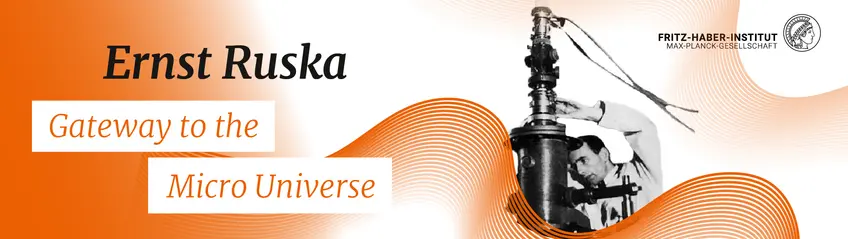
The Fritz Haber Institute of the Max Planck Society is organizing a special commemorative symposium (link below) to celebrate the 40th anniversary of the award of Nobel Prize to Prof. Ruska for the invention of the transmission electron microscope and what would have been his 120th birthday. Website